
1
If you were asked to name the best coach in football history, who would come to mind? Some might think of Mourinho, others Guardiola, or maybe Rinus Michels, and others might say Simeone. There are many great coaches, and listing them all would make this text very long. But we can focus on the pin point.
To decide the all-time best, one important rule is that the player or coach should be retired. We shouldn’t judge greatness in the middle of someone’s career because emotions often overpower logic. However, people still try. One respected selection of the greatest coach so far happened in 2013 by World Soccer magazine, where 73 experts each voted for five managers they considered the best. Alex Ferguson won first place with 49 votes, and Rinus Michels came in second with 46 votes.
How much should we value this voting? Many still believe Michels is the greatest because he started a new era in football. But Ferguson was certainly among the top coaches until at least 2013.

Analyzing this from another angle, the most prestigious award for English Premier League managers is the League Managers Association Awards, where peers vote. Alex Ferguson won it the most times, four in total. Additionally, he holds the record for the Premier League Manager of the Season award, with 11 wins, far ahead of Wenger and Mourinho, who each won it three times. He’s the only coach to win it three years in a row and also holds the record for Premier League Manager of the Month with 27 awards, with Wenger in second at 15.
Being first is always important, but the greats often set themselves far apart from second place, and Alex Ferguson achieved that in many ways. However, his success didn’t come easily—there were many challenges along the way.
2
Ferguson as a Player
At just 16, Ferguson began playing for the amateur club Queen’s Park, scoring 20 goals in 31 matches from 1957 to 1960. Frustrated by limited chances, he moved to St. Johnstone in 1960, where he faced similar challenges. Even after consistently scoring goals, he wasn’t included in the starting lineup until finally, in a match against Rangers, he was given a chance and scored a hat-trick. In 1964, he was signed for Dunfermline Athletic after this performance.

Dunfermline came close to winning the Scottish League but lost by a single point, and though they reached the Scottish Cup final, they lost 3-2 to Celtic. Despite his strong season, scoring 31 goals, he was left out of the final squad after a poor performance against Johnstone. Still, his 31 goals made him the league’s top scorer that season, after which he joined Rangers in a record-breaking transfer for £65,000.
He played 41 matches and scored 25 goals with Rangers, though he was blamed for their loss in the 1969 Scottish Cup final. He joined Falkrik as a player-coach. He was proposed by Nottingham Forest but they can’t as Fergi’s wife didn’t want to go England. When a new manager took over, Ferguson was relieved of his coaching duties, prompting him to join Ayr United, where he retired as a player in 1974.
3
Beginning of a Coaching Career of Ferguson
Ferguson coached first Stirlingshire in 1974. That time he was 32 aged. The job paid him €40 weekly as a part-time position. Later that year, another club, St. Mirren, offered him a coaching position. Under Ferguson, St. Mirren won the Second Division championship in 1977, though he was later dismissed for issues with a female assistant and poor relationships with players. He was fired and this happened only one time in his entire career.
He then joined the Scottish club Aberdeen. In his first season, Aberdeen finished fourth in the league and lost in the Scottish Cup semi-final. But from the 1979-80 season, Aberdeen started to shine under Ferguson. In 1980, they won the Scottish League, becoming the first team besides Celtic or Rangers to do so in 15 years. Aberdeen also won their first Scottish Cup under Ferguson in 1982. He declined offers from Arsenal and Tottenham and shocked everyone by succeeding in Europe, eventually defeating Real Madrid in the European Cup Winners’ Cup final.
4
Ferguson Entry into the English League
In 1986, Ferguson’s career reached its most crucial moment. Ron Atkinson had just left Manchester United, a team then struggling at 21st place in the league. The club’s management announced Ferguson as the new coach. Though he aimed to bring excitement to the club, fans had mixed feelings.

At the time, Manchester United was in poor shape, not just due to their low league standing but also because key players like Bryan Robson and Norman Whiteside were battling addiction and personal issues. Ferguson finished the season in 11th place. In his second season, he surprised everyone by finishing second behind Liverpool but fell back to 11th in the following season.
5
Starting to Succeed for Ferguson
George Best was legend of Manchester United. In the 1992-93 season, Ferguson signed French forward Eric Cantona, and Manchester United won the Premier League title for the first time in 26 years. By 1996-97, they had won the league four times in five years.

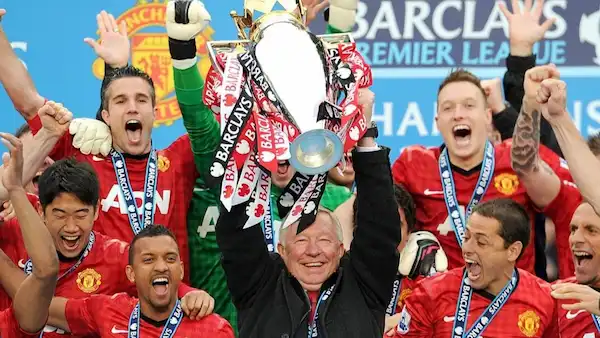
His most remarkable success came in 1998-99 when Manchester United won the Premier League, FA Cup, and Champions League, completing the treble. For this, Ferguson was knighted by Queen Elizabeth II, earning the title “Sir.” Manchester United set a record by winning three consecutive league titles from 1999 to 2002.
Ferguson then rebuilt the team with younger players like Cristiano Ronaldo, Ruud van Nistelrooy, Rio Ferdinand, Wayne Rooney, Nemanja Vidić, Edwin van der Sar, Michael Carrick, Park Ji-sung, and Patrice Evra. With this group, Ferguson achieved great success, winning his ninth league title in the 2006-07 season.
6
Legacy of Sir Alex Ferguson
Under Ferguson, Manchester United became the dominant force in English football, winning 13 Premier League titles and a total of 49 trophies across his career. He became known for chewing gum on the sidelines and rarely missed matches, standing in the dugout for over 1,400 games. His influence even created the term “Fergie Time,” referring to the dramatic wins United often secured in extra time.

He was also known for his long-term vision, focusing on team chemistry and developing players rather than spending large sums on established stars. Many of his players went on to succeed at other major clubs.
7
Conclusion
Whether you’re a player or a coach, you become truly important when your team misses you in your absence. Just how crucial was Sir Alex Ferguson to Manchester United as a coach? Between the 1992-93 season and his retirement, United became league champions 13 times, runners-up five times, and third-place finishers three times. He remains the only coach in the English league to finish in the top three for 20 consecutive seasons. Ferguson won the Premier League title 13 times, more than twice as many as the next most successful manager. He was the first English league coach to win three consecutive league titles, and he managed this feat twice.

But after Ferguson retired, United struggled. In the season right after he left, they dropped to 7th place, then finished 4th and 5th in the following two seasons, despite big signings and coach changes. This paints a picture of just how impactful Ferguson was for Manchester United.
In such an accomplished career, did he have any regrets? That remains unknown, as it’s a personal matter. However, one area of incompleteness might be that he never coached a national team at the World Cup. Ferguson showed no interest in managing a national team, but this missing piece didn’t hinder his greatness. Who knows, perhaps even now, he might still feel the urge to lead a team to a World Cup victory. After all, many professionals have come out of retirement to achieve new goals.
Until then, football fans can only wait and wonder.